Introduction to Peirce

Charles Sanders Peirce's semiotics is a comprehensive philosophical framework that defines a sign as a triadic relation between the representamen (the form the sign takes), the object (what the sign refers to), and the interpretant (the understanding or meaning generated in the mind of the interpreter). Unlike Ferdinand de Saussure's dyadic model, Peirce emphasized that meaning is not fixed but continuously evolves through interpretation, forming an ongoing process called semiosis. He classified signs into three main categories: icons (which resemble their objects, like a portrait), indexes (which have a direct connection to their objects, like smoke to fire), and symbols (which are based on learned or arbitrary associations, like words). Peirce's model laid the groundwork for much of modern semiotic theory, influencing logic, linguistics, communication studies, and philosophy.

Videos

Books

Charles Sanders Peirce by Joseph Brent

ISBN: 9780585037462
Publication Date: 1998-01-01
Joseph Brent’s Charles Sanders Peirce: A Life (revised and enlarged edition, 1998) is the first full biography of the American polymath Charles Sanders Peirce—widely recognized as the founder of pragmatism—published nearly eighty years after his death. Born in September 1839 and passing away in early 1914, Peirce made groundbreaking contributions across a remarkable array of fields, including mathematics, astronomy, chemistry, logic, semiotics, and philosophy. Brent draws extensively from unpublished letters and archival documents to paint a vivid portrait of Peirce as a deeply brilliant yet tragically underappreciated scholar—tormented by chronic illness, mood disturbances, and a persistent inability to secure a stable academic position that would have fostered his work in logic. The biography details how much of Peirce’s work remained unpublished during his lifetime and only later was organized and made accessible to the public.
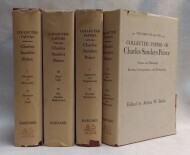
Collected papers of Charles Sanders Peirce

Publication Date: 1960-1966
The Collected Papers of Charles Sanders Peirce is an eight-volume compendium of Peirce’s writings, originally compiled between 1931 and 1935 (Volumes 1–6) by Charles Hartshorne and Paul Weiss, with Volumes 7 and 8 added in 1958 under the editorship of Arthur W. Burks. These volumes cover a wide spectrum of themes, from foundational philosophy and logic (Volumes 1–2), exact logic and mathematics (Volumes 3–4), to pragmatism, metaphysics, the philosophy of science, and estate materials such as reviews, correspondence, and bibliography (Volumes 5–8).

Writings of Charles S. Peirce: a Chronological Edition, Volume 8 by Charles S. Peirce; Cornelis de Waal (Other); André De Tienne (Other); Peirce Edition Peirce Edition Project (Editor)

ISBN: 9780253372086
Publication Date: 2009-12-07
Volume 8 of this landmark edition follows Peirce from May 1890 through July 1892?a period of turmoil as his career unraveled at the U.S. Coast and Geodetic Survey. The loss of his principal source of income meant the beginning of permanent penury and a lifelong struggle to find gainful employment. His key achievement during these years is his celebrated Monist metaphysical project, which consists of five classic articles on evolutionary cosmology. Also included are reviews and essays from The Nation in which Peirce critiques Paul Carus, William James, Auguste Comte, Cesare Lombroso, and Karl Pearson, and takes part in a famous dispute between Francis E. Abbot and Josiah Royce. Peirce's short philosophical essays, studies in non-Euclidean geometry and number theory, and his only known experiment in prose fiction complete his production during these years. Peirce's 1883-1909 contributions to the Century Dictionary form the content of volume 7 which is forthcoming.

Charles Sanders Peirce in His Own Words by Torkild Thellefsen (Editor); Bent Sorensen (Editor)

ISBN: 9781614516422
Publication Date: 2014-08-25
In 2014, Peirce will have been dead for one hundred years. The book will celebrate this extraordinary, prolific thinker and the relevance of his idea for semiotics, communication, and cognitive studies. More importantly, however, it will provide a major statement of the current status of Peirce's work within semiotics. The volume will be a contribution to both semiotics and Peirce studies.

Introduction to Peircean Visual Semiotics by Tony Jappy; Gregory Paschalidis (Series edited by)

ISBN: 9781441151636
Publication Date: 2013-03-14
Contemporary culture is as much visual as literary. This book explores an approach to the communicative power of the pictorial and multimodal documents that make up this visual culture, using Peircean semiotics. It develops the enormous theoretical potential of Peirce's theory of signs of signs (semiotics) and the persuasive strategies in which they are employed (visual rhetoric) in a variety of documents. Unlike presentations of semiotics that take the written word as the reference value, this book examines this particular rhetoric using pictorial signs as its prime examples. The visual is not treated as the 'poor relation' to the (written) word. It is therefore possible to isolate more clearly the specific constituent properties of word and image, taking these as the basic material of a wide range of cultural artefacts. It looks at comic strips, conventional photographs, photographic allegory, pictorial metaphor, advertising campaigns and the huge semiotic range exhibited by the category of the 'poster'. This is essential reading for all students of semiotics, introductory and advanced.

Why We Prefer Peirce to Saussure (T.L. Short - Semiotics, 1988)